
































Life’s Treasures
Fairy
Doors


Sleep Disorders
Definition
Restless legs syndrome (RLS), also known as Ekbom’s syndrome, refers to an unpleasant feeling in the legs that typically occurs in the evening, primarily when an individual is at rest. These sensations compel the person to move their legs to get relief, only to have the symptoms recur. These difficult to describe sensations in the legs are experienced as “tingling”, “itching”, “creeping crawling”, and are occasionally painful. Infrequently, RLS symptoms occur in the face and arms.
Description
About 10 percent of people between the ages of 30 and 79 have restless leg syndrome (RLS) at least five times per month. RLS affects individuals of all ages, with a more common occurrence in women. Its prevalence tends to increase with age and it appears to be occur more commonly in people of European and North American background.
People with RLS have difficulty falling and staying asleep and suffer from chronic sleep deprivation, which can lead to fatigue, depression, and an increased risk of accidents due to slowed reflexes.
About 80% of people with RLS are also affected by a similar condition that occurs during sleep, known as periodic limb movement disorder. This disorder is characterized by repetitive limb twitching during sleep (as opposed to RLS which occurs when awake), which can also disrupt sleep.
Causes
In many cases, RLS is a primary disorder, meaning that it is unrelated to other medical conditions, but it also can be associated with a variety of underlying medical disorders. The exact cause of RLS is unknown. In previous years, research has centred on the dopamine supply in the brain, but newer research suggests that it may actually have more to do with the iron levels in the brain. Interestingly, dopamine is involved in the processing of the brain’s iron stores and therefore may have an affect on RLS. In fact, the treatment of RLS revolves around dopamine-related drugs.
Primary RLS seems to have a genetic basis. Secondary RLS occurs in conditions such as pregnancy, iron deficiency, diabetes mellitus, kidney disease, neuropathy, spinal disease, and Parkinson’s disease. Strikingly, many of these conditions are characterized by inability to effectively use iron in the body.
Symptoms
Symptoms can occur during the day or night when sufferers are trying to sleep (nighttime symptoms are referred to as periodic leg movements in sleep). All patients who have day-time episodes also have nighttime discomfort, but the reverse is not true.
Episodes can last from a few minutes to several hours, and typically occur many times during the day or night, especially when sufferers relax or are trying to fall asleep (although they are not the same as "night starts," the sudden, jerky movements that sometimes occur when falling asleep). Symptoms are worse at the end of the day when the patient is either seated or in bed.
Regardless of when an episode strikes or how often it lasts, the only way to obtain relief is to get up and walk around - although symptoms usually resume once patients sit or lie down again. In addition to walking, those with RLS can make certain
adjustments to keep their daily routines as normal as possible.
Diagnosis
The diagnosis is made based on the medical history including symptoms and the physical examination. A sleep study is not necessary to diagnose restless legs syndrome, but periodic limb movement disorder can only be assessed with an overnight sleep study. Also, if symptoms of RLS are present, iron deficiency needs to be ruled out with blood tests.
Treatment
Treatment for RLS includes pharmacological and non-pharmacological methods. Often symptoms respond to warm baths, hot packs, stretching exercises, walking, or massaging the legs. As noted earlier, iron deficiency has been associated with RLS, so iron pills will often be prescribed. In addition, many medications can lead to some improvement in the symptoms of RLS and the exact type of medication is usually dictated by the frequency of the symptoms. The symptom occurrence can be divided into intermittent, daily, and refractory. For intermittent symptoms, a medication that contains dopamine (levodpa/carbidopa--typically a treatment for Parkinson’s disease) is usually used on an as needed basis. For daily symptoms, two medications, pramipexole (Mirapex) and ropinirole (Requip) that increase the amount of dopamine in the brain are used on a daily basis. Other medications such as benzodiazepines and opiates help induce sleep and often improve the uncomfortable sensations of RLS. When symptoms persist some anti-seizure medications, such as gabapentin (Neurontin), can be added.
An interesting phenomenon, called augmentation, can occur in those taking dopamine-related medications. Augmentation is when RLS symptoms start earlier in the day, symptom intensity increases, or spread to the arms. This is often managed with medication additions and adjustments


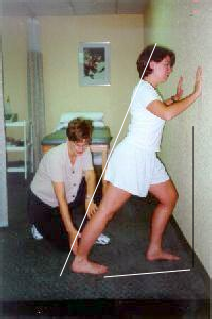
In the picture left the client is being guided to place the foot central to a line square to the support or wall (lie under middle toe and centre of heel) this is to train the ankle joint in the angle that it should operate at, Then the other foot should be placed alongside the imaginary line the same time as the hands are placed on the wall to support the weight at this point you should be almost a straight line through the heel, back and head, at this point you should feel comfortable with no pain or tension in the back of the leg and the heel should be flat to the floor at all times from this point on.
Now by bending the bent knee and elbows very slightly you should feel a tightness (NOT pain) in the calf of the back leg you now lock your body so you neither go forward or backward you must maintain this position for at least 25 seconds, DO NOT move, after 25 seconds is up the tension in your calf will have now disappeared
but now we again bend our knee and elbows to bring back the tightness for the second time the tension will feel higher up the calf in the knee joint area when the 25 seconds is up the tension in your calf will have disappeared again, again adjust knee and elbows to bring back the tension again for the third and last time on this leg again after 25 seconds, the tightness will disappear but this time don’t throw yourself upright take it steady otherwise you will lose the thread.
You now have to repeat the moves again with the other leg.
On the left is a summary in steps as a guide to remembering the salient points.
NB if you dont have access to a timer you can count 42 slowly this is around 25 seconds and as you reach 42 your tension will be reduced or reducing, if it isnt then you are counting too fast.


Clickable Links
Gleanings
Definitions
Sleep Disorders vary in nature and degree. The three major sleep disorders are dyssomnias (insomnia), hypersomnia (disorders of excessive sleepiness) and parasomnias (abnormal behaviours during sleep).
Sleep consists of two distinct states: REM (rapid eye movement) sleep and NREM (non-REM) sleep. Dreaming occurs mostly in REM sleep.
Sleep is a cyclic phenomenon, with four or five REM periods during the night, which accounts for about 25 percent of the total night’s sleep.
Insomnia, the sense of not getting enough sleep to awake refreshed, affects 20 to 40 percent of all adults in the course of any year. Although insomnia has myriad causes, it can roughly be divided into three categories: predisposing, precipitating and perpetuating.
Predisposing factors ~~ are the built-in characteristics of a person that make him or her vulnerable. Tense or driven people whose heads are brimming with plans or worries can easily lose sleep. Others with severe depression often cannot sleep through the night. In manic disorders, sleeplessness may be important early sign of impending mania in bipolar patients. A few have neuralgic or other conditions that affect them mainly at night - restless legs syndrome (for example) or the involuntary twitching of leg muscles (nocturnal myoclonus).
Precipitating factors ~~are events in life that trigger a period of disturbed sleep. Stresses that precipitate insomnia may include an increase in responsibilities, the loss of a loved one, hospitalisation or acute pain, to name a few. An abrupt alteration of schedule, resulting from a change of shift at work or jet lag, can also provoke insomnia.
Perpetuating factors ~~ are behaviour that help to maintain sleeplessness once it has begun. These include irregular sleep habits and the use of drugs. Abuse of alcohol may cause or be secondary to the sleep disturbance. Heavy smoking (more than a pack a day) causes difficulty in falling asleep. When sleeping pills help, it is mainly with the precipitating causes of insomnia and only then for a relatively brief period of time.
Short-term or transient insomnia is seen in people who have no history of sleep disturbances and who have a fairly obvious precipitating factor. Taking sleeping pills for a short period of time (perhaps a few days) may be helpful in such cases, and there is little controversy about prescribing them to help people through a crisis. However, chronic insomnia (defined as three weeks or more of almost nightly sleep difficulty) is rarely helped by drugs.
Waking too early may represent a rebound from use of alcohol at bedtime or even from certain types of sleeping pills. It is also a symptom of depression. Some people sink into depression gradually, and feeling blue eventually becomes a chronic way of living. Others focus on poor sleep, telling themselves and others, "Life would be much better if only I could get a decent night's sleep."
The tendency to be early to bed and early to rise increases as we grow older. Most persons adapt successfully but some of us find that our bodies say, "It's bedtime," earlier than we desire – often well before 9 p.m. Known as advanced sleep phase syndrome (or ASPS) this problem can wreak havoc with social life. Most persons with ASPS try numerous strategies to help them stay awake. Even if they succeed in pushing bedtime later, they may not be able to sleep any later because their body clocks still awaken them in the early morning hours.
It is important to note that age-related changes in normal sleep include an increase in wakeful periods during the night. These normal changes, early bedtimes and daytime naps, may play a role in the increased complaints of insomnia among older persons.
Will affect most stages of the above does not involve taking medication and will remain active for up to 9 months, downside is that the hops have a strong aroma akin to gorgonzola cheese but if it works who cares? (This aroma will be offset by using a lavender wand alongside). (HOP n KIP) they are designed to fit inside the pillow case flap, but will work even on the bedside table or under the bed,
We have now started supplying these as a pack of Hops and Lavender sealed in case anyone is overcome whilst driving home they can be that potent.
It can be used as good indication that there may be a possibility of a need for medical treatment IF they don’t work.
The word "apnoea" means the absence of breathing. During sleep, our breathing changes with the stage or depth of sleep. Some individuals stop breathing for brief intervals, however, when these episodes of apnoea become more frequent and last longer, they can cause the body's oxygen level to decrease, which can disrupt sleep. The patient may not fully awaken, but is aroused from the deep restful stages of sleep, and thus feels tired the next day.
There are two main types of sleep apnoea which may occur together.
The most common is obstructive sleep apnoea, during which, breathing is blocked by a temporary obstruction of the main airway, usually in the back of the throat. This often occurs because the tongue and throat muscles relax, causing the main airway to close. The muscles of the chest and diaphragm continue to make breathing efforts, but the obstruction prevents any airflow. After a short interval lasting seconds to minutes, the oxygen level drops, causing breathing efforts to become more vigorous, which eventually opens the obstruction and allows airflow to resume. This often occurs with a loud snort and jerking of the body, causing the patient to arouse from deep sleep. After a few breaths, the oxygen level returns to normal, the patient falls back to sleep, the muscles of the main airway relax and the obstruction occurs again. This cycle is then repeated over and over during certain stages of sleep. Most people with obstructive sleep apnoea snore suggesting that their main airway is already partly obstructed during sleep, but not all people who snore have obstructive sleep apnoea.
A less common form of sleep apnoea is central sleep apnoea, so named because the central control of breathing is abnormal. This control centre lies in the brain, and its function can be disrupted by a variety of factors. There is no obstruction to airflow. The patient with sleep apnoea stops breathing because the brain suddenly fails to signal the muscles of the chest and diaphragm to keep breathing. These patients do not resume breathing with a snort and body jerk, but merely start and stop breathing at various intervals. Although the mechanism is different than obstructive sleep apnoea, sleep is still disturbed by the periodic decreases in oxygen, and the patients suffer from the same daytime symptoms. Some patients may suffer from a combination of the two causes of apnoea, a disorder which is called mixed-sleep apnoea.
Sleep apnoea should be suspected in individuals who are noted to have excessive daytime sleepiness and other symptoms described above, especially if they are known to snore and have a restless sleep. Commonly, these patients have exhibited loud snoring for many years, more often are male, and note that the daytime sleepiness has become a progressive problem over many months. Less commonly, they may be bothered by bed wetting or impotence. The sleep problems are often aggravated by alcohol or sedative medications. They are also more readily noticed by the patient's family and friends, especially the bed partner.

Narcolepsy is a chronic sleep disorder, characterized by excessive sleepiness and accompanied by a series of auxiliary symptoms, typically beginning in adolescence or young adulthood. It affects both sexes approximately equally. The principal symptoms are excessive daytime sleepiness (ED'S), cataplexy (loss of muscle tone), hallucinations, sleep paralysis and disrupted night time sleep. Doctors also diagnose narcolepsy by measuring how quickly the patient falls asleep and how often rapid eye movements are present at or near the onset of sleep.
Narcolepsy is a lifelong illness. There is no known cure and no report of lasting remission has been confirmed. Typically, symptoms (usually ED'S) first become noticeable between the ages of 10 and 30. Symptoms are subtle at first, but become increasingly severe over the years. Narcolepsy may be treated with daily administration of a stimulant (e.g. dextroamphetamine sulfate).
Cataplexy is an abrupt loss of voluntary muscle tone, usually triggered by emotional arousal. Attacks can range in severity from a brief sensation of weakness to a total collapse, lasting several minutes. Hallucinations are intense, vivid, sometimes accompanied by frightening auditory, visual and tactile sensations, and occur on just awakening or falling asleep.
(Imipramine has been effective for cataplexy, not narcolepsy.)
Diagnosis
Your physician will take a complete medical history, perform a physical exam and may suggest additional tests, including sleep studies.
Treatment
Treatment varies, depending on the specific sleep disorder, but may include psychologic strategies as well as medications.


Take back your body
Talk to the Manager
This is a style of stretch that I have designed to assist in the re-training of damaged and under used muscles to give comfort in some cases whilst giving the athlete a better chance of success in their chosen sport or passtime.
I am including it in this file because it is designed to bring relief to sufferers of restless leg syndrome and leg cramps and is benefitial to children susceptible to shin splints.

Summary
1} Position heel See picture above
2} Position arms and other leg
3} Feel tension by leaning forward
4} Lock whole body Start timing.
5} 25 second or until tension disapears
6} Carry out steps 2 to 6
7} Then steps 2 to 6 again (3 times in total)
8} Stand upright slowly
9} Change legs.
These have to be carried out 3 times on each leg then start again for one more set
| Rules of the Air |